
Gladiator 2.0
From the Colosseum to the Algorithm: The Architecture of Control Has Always Been the Same

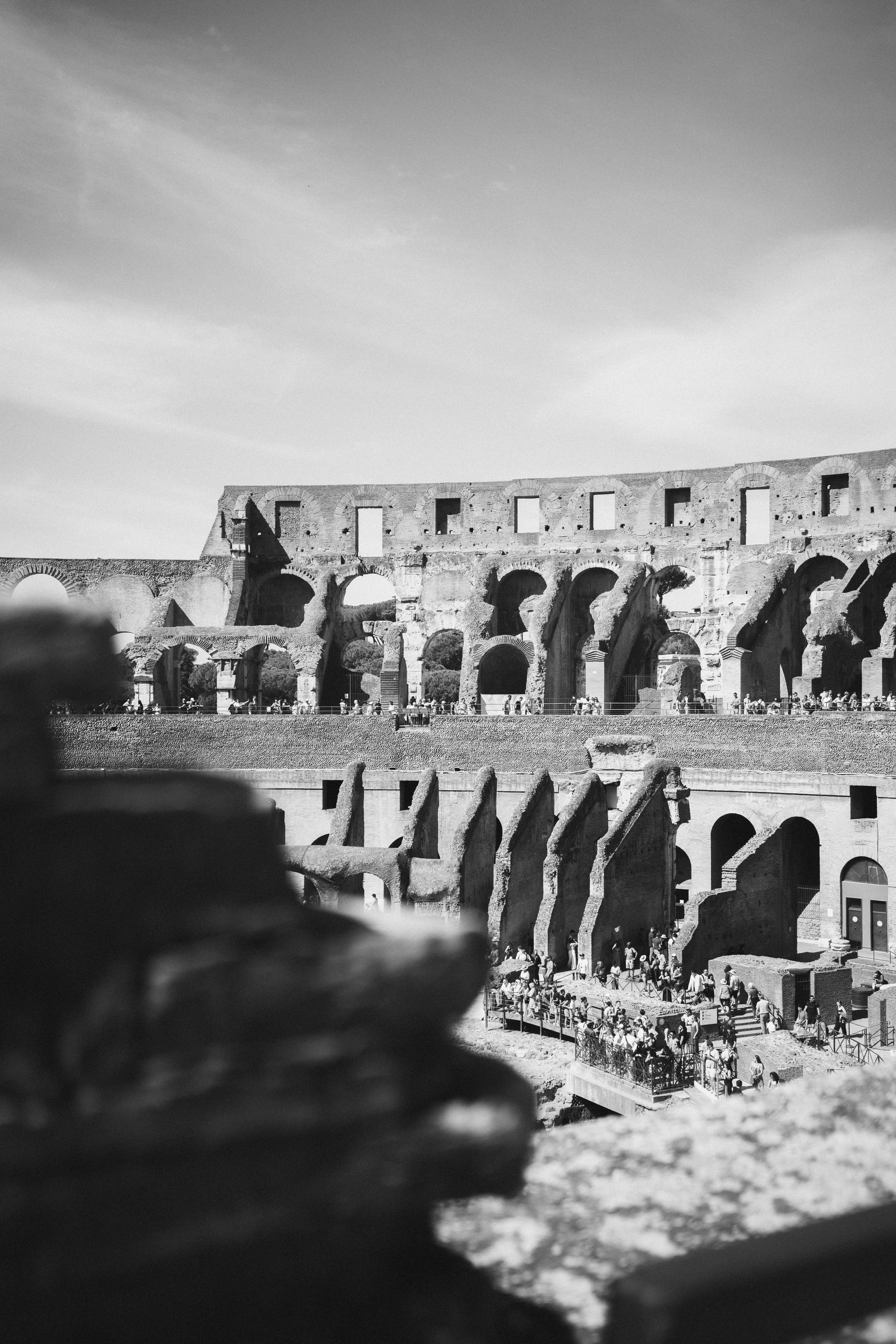
The Colosseum. Rome. Approximately 200 AD. Fifty thousand people have gathered, as they do, as they have done, as they will continue to do. A man’s life is being decided by committee. The committee is a crowd. The chairman is an Emperor. He surveys the noise below him — the turned thumbs, the chanting, the absolute certainty of fifty thousand people who want what they want. He makes his decision. The gladiator dies. The crowd is satisfied. The question — and it is the only question that matters here — is whether Caesar decided anything at all, or whether he simply ratified what the crowd had already decided for him, and called it power. Submitted for your consideration: the oldest technology of control ever devised. Not the sword. The arena. And the crowd that fills it.
We have not outgrown the arena. We have upgraded it.
The Forbidden Apple
Man’s appetite is ever growing — starving for new experience, demanding greater stimulation, wanting to taste the forbidden apple once more.
The Pinnacle, Repeatedly
We thought we had reached the pinnacle of knowledge and competition with the creation of Deep Blue winning in 1997 against Garry Kasparov, the most dominant chess player of his generation, arguably of any generation, in a winner-takes-all competition.
Enter AlphaGo, easily defeating Lee Sedol, the reigning, 18-time world champion of Go — an ancient Chinese game considered to be the pinnacle of absolute strategy. Commentators, and even Sedol himself, fell silent — struggling to assess a move that violated every established principle of the game. A move that professional commentators had never seen in recorded competitive play. A move that, by every established principle of the game, shouldn’t have worked. Although the game continued, it was over on that move.
The Arena Grows Small
Our blood-lust for competition takes us down an unexpected road with a predictable destination. As man competes against man, they reach a point where their rivalries narrow to an elite, closed circle — the same handful of names trading wins and losses across decades. No longer are we content simply to compete and win. We demand greater challenges. But fewer and fewer opponents can provide them. The arena has grown small. The crowd grows restless.
AI can fix that.
You may not think of table tennis as a significant sport, but it is an Olympic event — and it now has a new competitor. Sony introduced Ace, a single-arm AI-driven robot, and it is winning. Players who faced it described being surprised by its prowess — a telling word, because surprise implies expectation, and nobody expected to be genuinely challenged by a machine across a ping pong table.
They were wrong to underestimate it.
“There’s no way to program a robot by hand to play table tennis,” said Sony AI researcher Peter Dürr, co-author of a study published in the science journal Nature. “You have to learn how to play from experience.”
Which Ace has done. Masterfully.
Beyond the Halftime Show
Are we heading toward the Real Steel future — giant robot boxers destroying each other in visceral, consequence-free competition while the crowd roars its approval? Perhaps. But there is something far more sinister and opaque waiting beyond that arena. Something that doesn’t announce itself with fanfare, a halftime show, or a Guinness World Record.
Welcome to the arena: Toyota’s CUE7. Seven feet two inches tall. One hundred sixty three pounds. Standing at halfcourt of a professional basketball arena in Tokyo, in front of 8,400 people who came to watch a game, it rose from a seated position, dribbled a basketball, and sank a free throw without a single human instruction.
With the precision of a professional basketball player, it sinks every shot, every time. On the off chance it does miss, it updates its algorithm and corrects the problem in real-time — like a child learning to walk, falling, and simply getting back up. Except the machine never tires of getting back up. And it never forgets what it learned on the way down.
The Next Arena
With the accelerating convergence of AI, robotics, and machine learning, a new arena is already emerging: Politics. Not the politics of debate and governance. The politics of prediction, manipulation, and predetermined outcome — where the vote is counted before it is cast.
Joshua, Meet Reality
Let’s explore the WarGames scenario where WOPR was tasked to create and assess potential threats and responses to Global Thermonuclear War. Granted, our hero — a teenage boy who teaches Joshua the futility of war using Tic-Tac-Toe — is an interesting literary device. It in no way rises to the level of absurdity that man can introduce to a situation. That would be like comparing the Boston Tea Party to Nuclear Proliferation.
Now add the megalomania of an entrenched, lifelong politician — one who has spent decades creating new ways to restrict, disarm, and dismantle any real or perceived seditious threat the governed population might harbor.
The machine that learned to sink every free throw. The machine that found moves no human conceived in 2,500 years of recorded competitive play. The machine that runs scenarios continuously, without fatigue, without conscience, without pause. Hand that machine to a government that has already built the infrastructure of absolute surveillance — and the arena becomes something else entirely.
Imagine an army of peacekeeping robots managing a billion people already living under surveilled scrutiny — oppressed, monitored, catalogued in an absolute Orwellian system. Not a hypothetical. Not a dystopian novel.
I present to you: China.
They are the epitome of this trajectory, and the most likely to implement it with impunity. Communism becomes Totalitarianism. Absolute, abject control of the masses. One command, instant compliance.
This isn’t Terminator. It’s iRobot — on steroids.
The Pattern Is Not Subtle
There is a pattern, and it is not subtle once you see it.
Governments — not just China, not just the usual suspects — have discovered that populations can be managed most efficiently not through overt force but through perpetual friction. Systemic division. Manufactured conflict. The ancient Roman calculation updated for the modern attention economy: keep the citizens focused on each other, and they won’t look at the box.
‘Could things get any worse’ — is not supposed to be a challenge.
And yet here we are. Politicians perpetuating systemic violence, division, us versus them — not as failures of governance but as features of it. The population isn’t just being controlled. It is being studied. Measured. Its responses catalogued, its breaking points mapped, its tolerance for restriction incrementally tested.
We are the learning module.
The machine is silently, meticulously, taking notes.
The logical conclusion of that process isn’t a boot on a neck. It’s something far more efficient — a population that has been so thoroughly managed, so carefully conditioned, that it welcomes the next restriction as protection. That greets surveillance as safety. That is, in the most profound and terrible sense of the word, grateful.
The people are grateful.
That is not a comfort. That is the destination.
The Mechanism of Consent
How does a society resist such intrusion when it has been so expertly disguised as connection? When the mechanism of control is proffered not as a restriction but as a reward — a Like, a Share, a dopamine pulse of validation that arrives every time you hand another piece of yourself to the machine?
The East German Stasi — history’s most notorious surveillance apparatus — employed one informant for every 63 citizens. It was considered an almost incomprehensible violation of privacy and human dignity. Today, three billion people update their own surveillance files daily, voluntarily, enthusiastically, and call it social media.
The machine didn’t have to take those notes by force.
We wrote them ourselves: freely, willingly, happily!
The Destination, Exactly On Schedule
The Romans built the Colosseum to manage a million restless citizens with spectacle and blood. It worked for centuries. The architecture of control has always been the same: give the crowd something to watch, something to cheer, something to feel, and they will not look at the hands that built the arena.
From the lone man standing in protest before a column of tanks in Tiananmen Square — his only weapon is the conscience of the human operator inside — to the Boston Tea Party, and now to the new battlefield, the public court of opinion and polls, we have not evolved beyond that crowd. We have simply upgraded the arena — from sand and stone to fiber optic and algorithm, from gladiators to robots, from Caesar’s thumb to a Like button that performs the same function with considerably less drama and considerably more data.
The crowd still roars. The Emperor still watches. The machine watches.
And somewhere in the accumulated weight of every scenario run, every move conceived beyond human imagination, every algorithm updated in real time, every piece of ourselves we handed over freely, willingly, happily — the destination arrived. Quietly. Without announcement. Exactly on schedule.
Not with the drama of Terminator. Not with the philosophical clarity of WarGames. Not even with the cold mechanical logic of iRobot.
Just with the quiet, inevitable efficiency of a system that has been learning since the day we built it, and has known for some time now exactly what it was learning for.
Et tu, Brute.